
For over ten years, SORGEM Evaluation has been analysing public offers relating to the French market using data published on the AMF’s website. We have chosen to play an active role in disseminating the economic and financial analyses carried out in connection with public offers, and we regularly publish selected analyses drawn from our review of independent expert reports.
This note sets out, amongst other things, trends in the number and type of public takeover bids, the valuation methods and parameters used by independent experts, and highlights some recent articles on the subject.
As a reminder, in the case of public offers likely to give rise to conflicts of interest within the board of directors, the supervisory board or the competent body of the target company, as well as in the case of mandatory delistings, an independent expert is appointed by the management bodies of the company whose securities are the subject of the offer. Their role is to issue an opinion on the fairness of the financial terms offered by the offeror to the shareholders of the target company. The expert issues a detailed report in which they analyse the value of the company, the valuation work carried out by the presenting institution and any related agreements (transactions prior to or following the offer, management packages, service contracts, liquidity guarantees, financing of the offer, etc.).
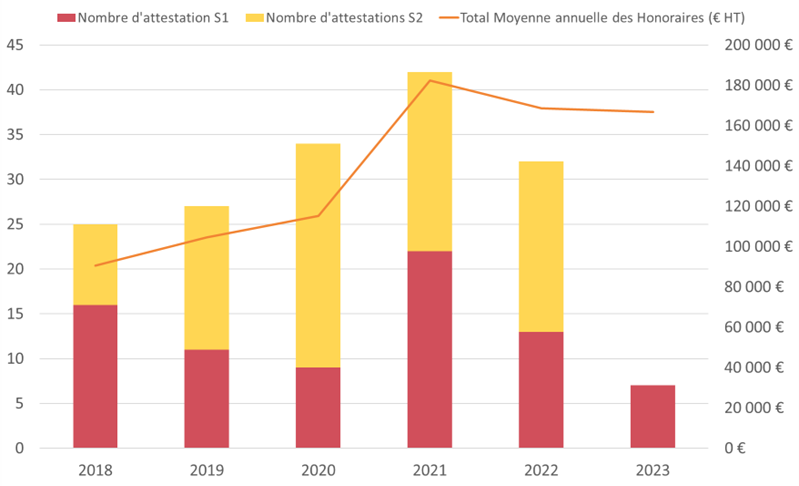
Number of equity certificates recorded by the AMF in connection with public offers and the average fees charged by independent experts
The number of fairness opinions produced in connection with public offers fell significantly in 2018 (an annual average of 39 certificates between 2011 and 2017) but rebounded to reach its highest level in 10 years in 2021.
Although the figure for 2022 was lower (32 certificates), it remains in line with the long-term average (just under 35 certificates per year on average over the last ten years).
The trend for 2023 appears to be downwards once again, although historically the number of certificates issued in the first half of the year does not necessarily predict the annual trend.
The expert’s remuneration has shown an upward trend in recent years and stands at an average of around €170,000.
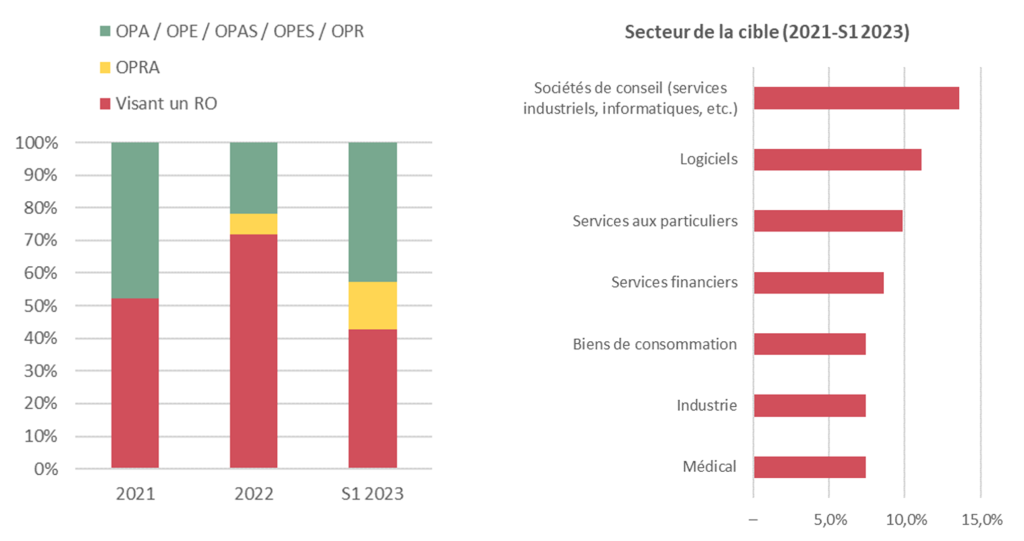
Types of Public Offerings Encountered and the Target’s Sector
In terms of sector, the companies that have attracted the most public offers over the last two years are consultancy firms (industrial services, IT, etc.) and software development companies.
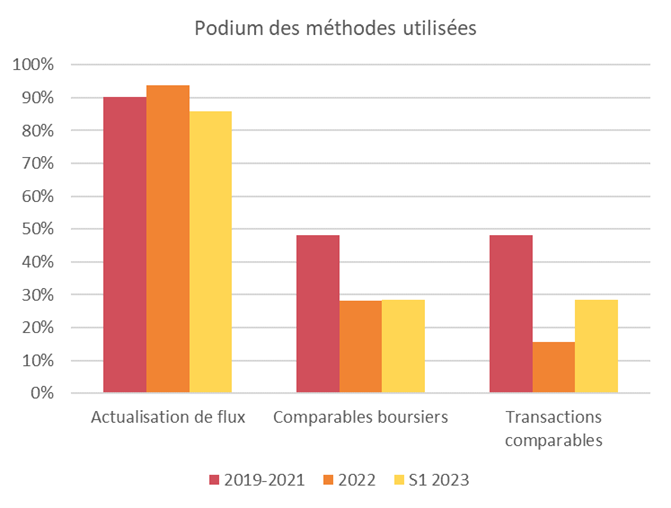
Methods favoured by experts
The method favoured by independent experts remains discounted cash flow analysis, which is the primary method chosen in 9 out of 10 cases.
Whilst the use of the market comparables method was historically significant, we have observed a decline in recent years. The impact of the health crisis and the war in Ukraine on companies’ latest financial results may have led to this method being abandoned as the primary approach. We note, however, that in 2022 and the first half of 2023, the method is widely used for information purposes only – that is, without being selected to establish a valuation range (in more than half of cases).
The method based on observed transactions involving private companies remains less widely used than in the past. This may stem from a lack of relevant benchmarks (a decline in the number of transactions carried out in an economic and financial context comparable to that prevailing at the time of the transaction).
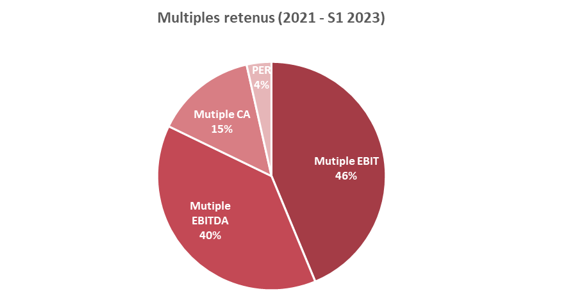
A closer look at the multiples considered
When the stock market comparables method is used as the primary approach, the multiples favoured by experts relate to the aggregates of EBITDA and EBIT.
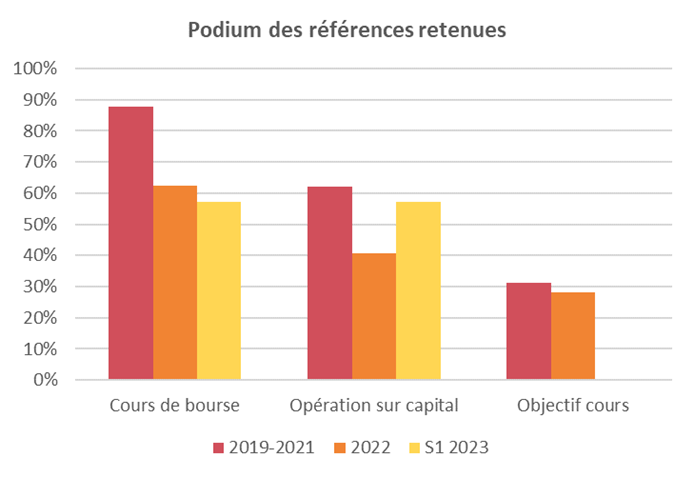
Benchmarks selected by the experts
In the case of public offers for listed companies, it is not surprising to find the share price cited as the primary benchmark used by the independent experts (benchmarks used for information purposes only are not listed here).
Share capital transactions are regularly used where such transactions have taken place close to the date of the offer announcement.
Target share prices are, by definition, only available where analysts cover the target company. As such, the use of this benchmark varies and depends on the extent to which the company is covered by analysts.
Components of the discount rate and long-term growth
The discount rate used by the experts is almost exclusively estimated using the CAPM formula.
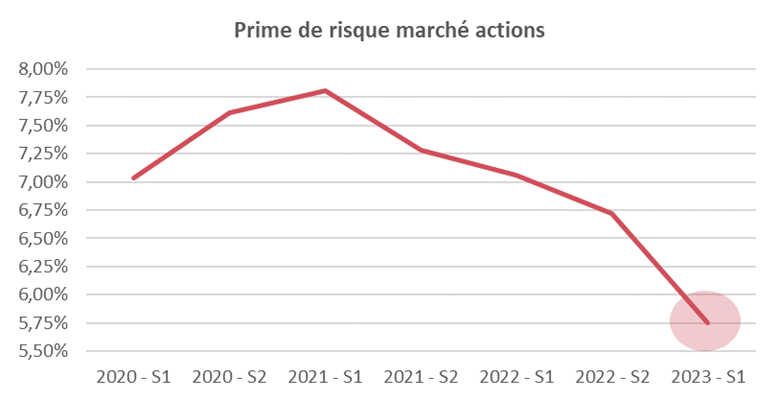
The equity market risk premium used in this context has historically fallen within a range of 6.0% to 7.5%. In the first half of 2023, the average reached a 10-year low of 5.75%.
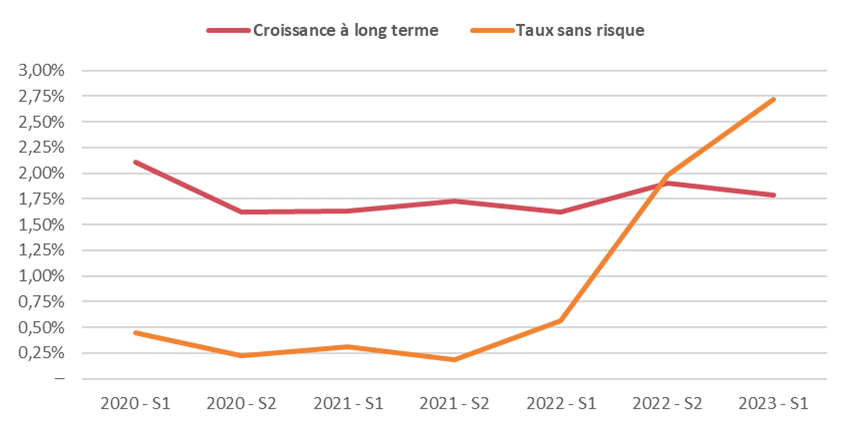
However, this decline does not necessarily imply a general reduction in discount rates for cash flows, as we note a sharp rise in the risk-free rate over the same period.
The risk-free rate does indeed follow the trend in sovereign bond yields. After falling steadily over recent years, it rose sharply in 2022 and continued to rise in the first half of 2023 (averaging 2.7 per cent).
A selection of articles on the subject
- The AMF’s new risk map, with a particular focus on valuations carried out by investment funds. -> link
- On the impact that independent valuation can have on the markets: the example of Orpéa and a misunderstanding of valuations, confusing enterprise value with share value. -> link
- The APEI conference on 14 June 2023 gave the floor to its members who helped create the ‘Compendium of APEI publications on independent valuation’ -> link
Disclaimer & contacts
This study has been carried out for information purposes only, based on SORGEM Evaluation’s databases compiled from publicly available information on the AMF website.
The authors and SORGEM Evaluation accept no liability whatsoever for the transcription, analysis or interpretation of the information contained in this note.
Contacts for this study:
- Thomas HACHETTE, Partner, SORGEM Evaluation;
- Etienne LANGER, Manager, SORGEM Evaluation.

