
For over ten years, SORGEM Evaluation has been analysing public offers relating to the French market using data published on the AMF’s website. We have chosen to play an active role in disseminating the economic and financial analyses carried out in connection with public offers, and regularly publish selected analyses drawn from our review of independent expert reports.
This note sets out, amongst other things, trends in the number and type of public takeover bids, the valuation methods and parameters used by independent experts and the lead underwriters, and highlights some recent articles on the subject.
As a reminder, in the case of public offers likely to give rise to conflicts of interest within the board of directors, the supervisory board or the competent body of the target company, as well as in the case of mandatory delistings, an independent expert is appointed by the management bodies of the company whose securities are the subject of the offer. Their role is to issue an opinion on the fairness of the financial terms offered by the offeror to the shareholders of the target company. The expert issues a detailed report in which they analyse the value of the company, the valuation work carried out by the presenting institution and any related agreements (transactions prior to or following the offer, management packages, service contracts, liquidity guarantees, financing of the offer, etc.).
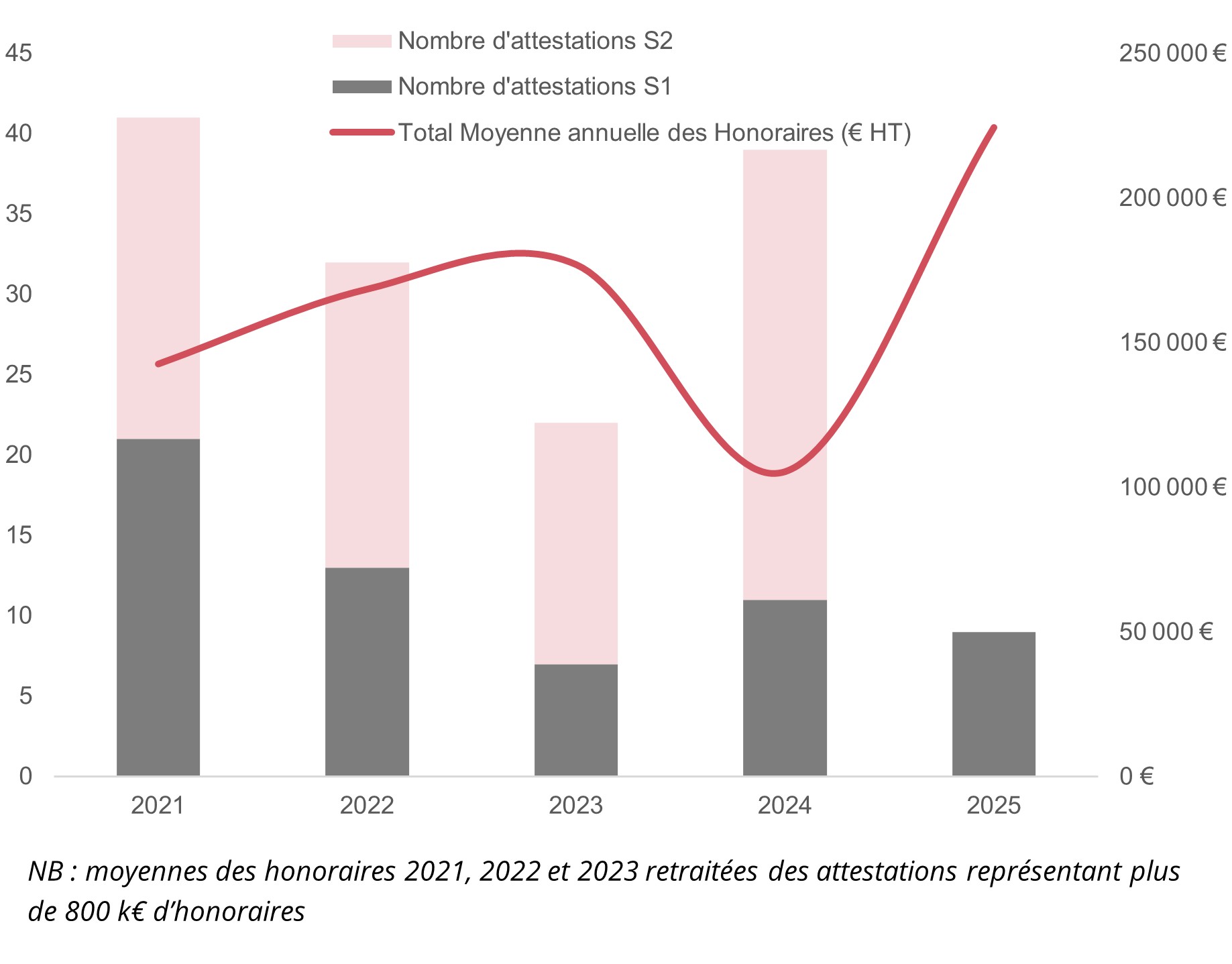
Number of fairness opinions recorded by the AMF in connection with public offers and the average fees charged by independent experts
The first half of 2025 saw a level of activity comparable to that of the first half of 2024, with nine fairness opinions produced in connection with public offers, but this figure is below the average for the last five years (just over 12).
This half-year has seen a greater focus on so-called ‘mid-cap’ companies. The median equity of the companies, estimated at the offer price, stands at €2.7 billion, ranging from €48.9 million to €7.2 billion.
At the same time, we are seeing an increase in the expert’s fee, which stands at around €224,000 on average in H1 2025 (compared with an average of just over €150,000 in previous years).
Types of public offers encountered and the target’s sector
In terms of sector, the companies that have attracted the most public offers over the last eighteen months are industrial firms, as well as those operating in the consultancy and software sectors.
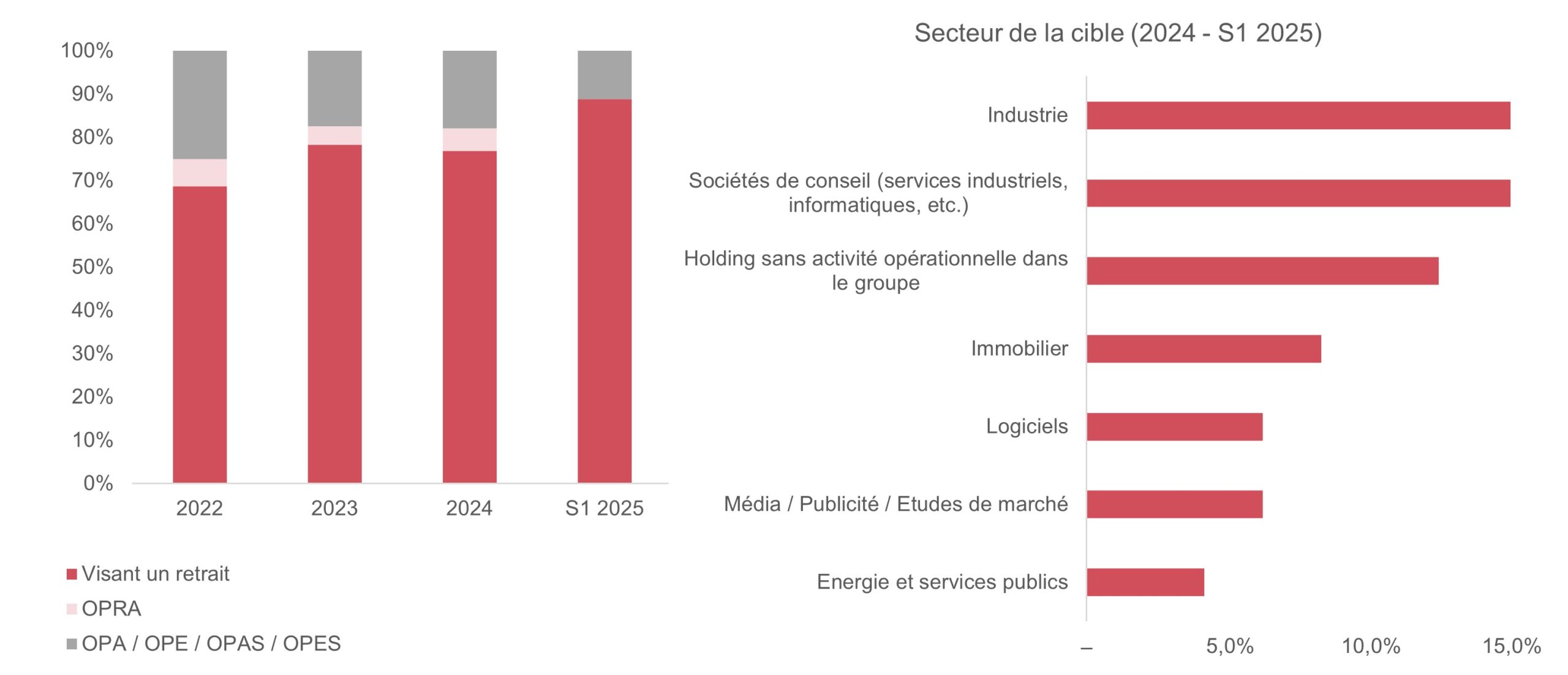
The sponsor’s intention to delist the company – which has been the case in the majority of instances for several years – is even more pronounced in the first half of 2025.
Premiums offered to shareholders
In recent years, there has been a general increase in the premiums offered relative to the average share price over the three months preceding the offer.
In the first half of 2025, the average premium observed relative to the share price (3-month average) stood at 59 per cent, compared with an average premium relative to the DCF valuation of around 18 per cent.
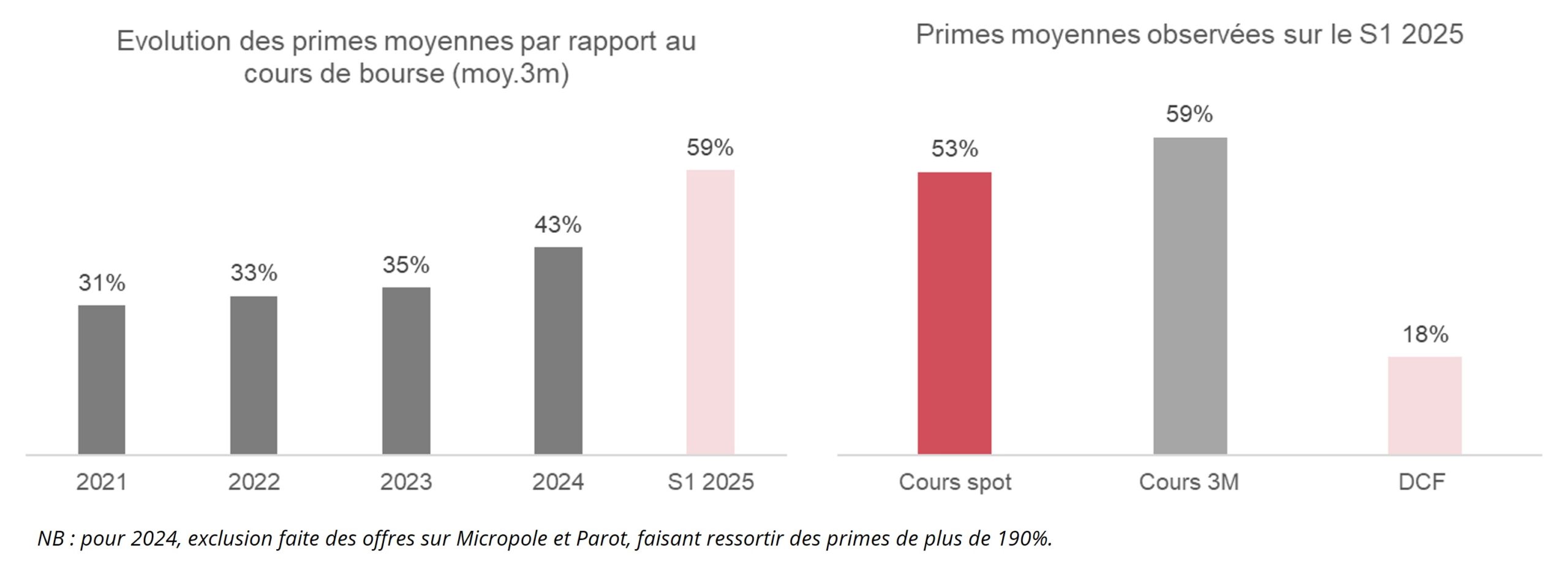
It is also worth noting that, on average, the smaller the stake held by an initiator prior to the offer, the higher the premium offered relative to the share price tends to be.
It should be emphasised, however, that the premiums offered mask significant disparities between the various offers.
Methods favoured by independent experts and the presenting banks
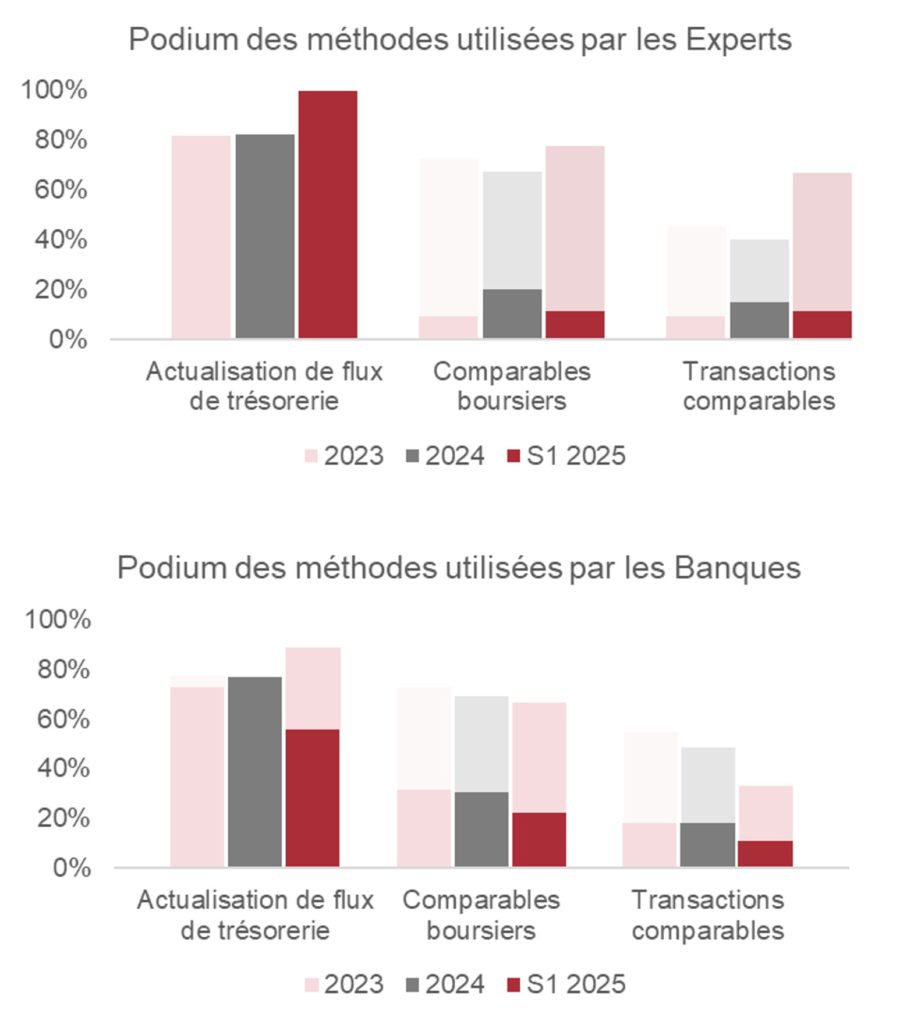
The method favoured by experts and banks remains discounted cash flow analysis, which is used as the primary method in most cases.
The market comparables method is presented more for information purposes only, i.e. without being used to establish a valuation range (shown in pale colour in the accompanying charts), particularly amongst valuers.
The second analogical method used by professionals, based on observed transactions involving private companies, has seen a marked decline in recent years amongst valuers. They indicate that the information required to assess the applicability of multiples is very often insufficient. Banks make more frequent use of this method, particularly for indicative purposes.
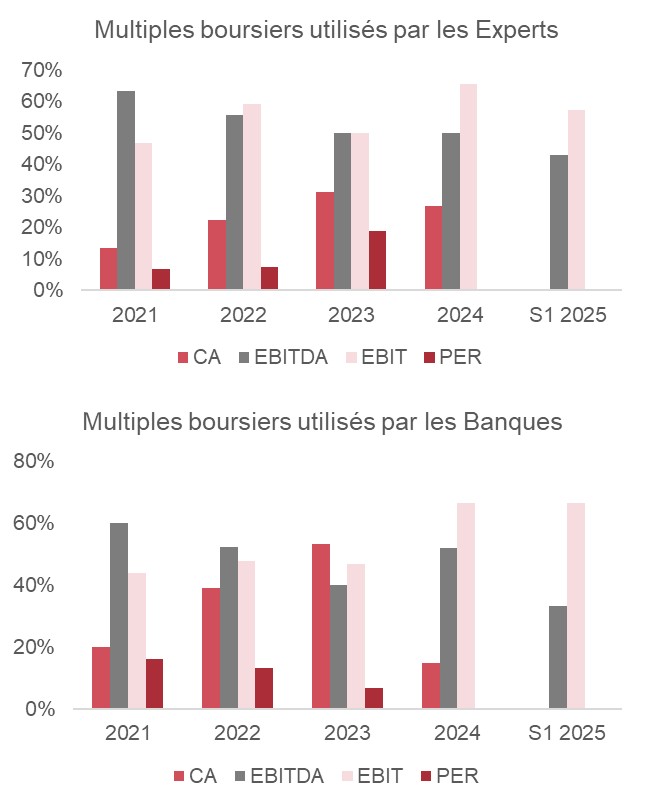
A closer look at the multiples considered by independent experts and underwriting banks
When the market comparables method is applied, experts and investment banks tend to favour EBITDA and EBIT aggregates.
The market multiples used by experts and banks have varied over recent years.
In the first half of 2025, there was a higher frequency of use of EBIT multiples by both experts and banks than in 2024. This trend can be explained, in particular, by a need for comparability between companies based on their investment policy (leasing or investment).
It is also noted that neither the experts nor the banks used the P/E ratio during the half-year, as was already the case in 2024. This may be explained by the absence of financial services companies amongst the targets, a sector in which this multiple is usually applied.
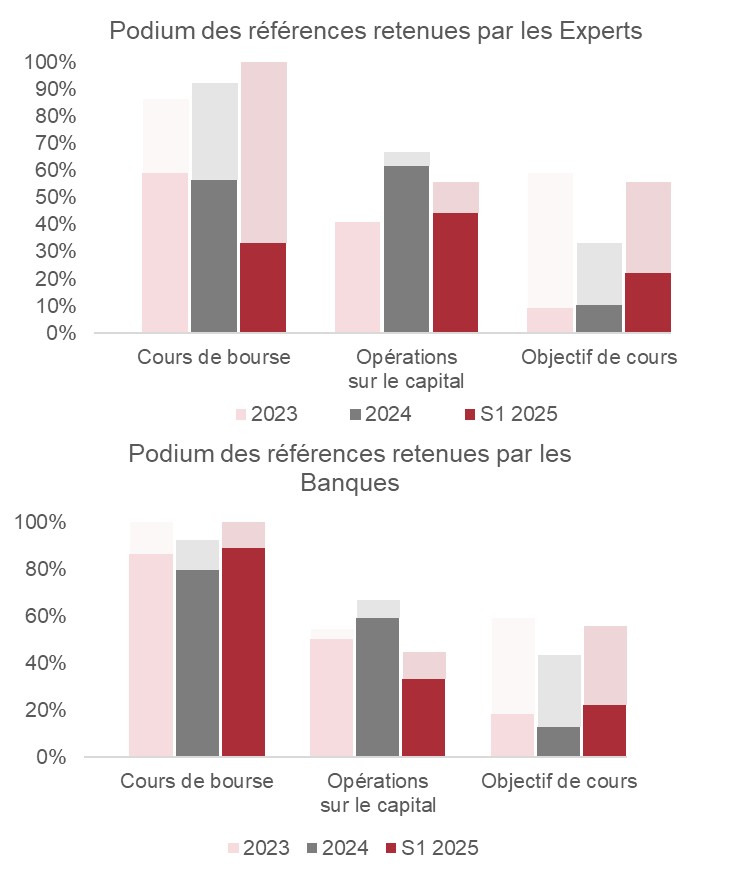
Benchmarks used by independent experts and the underwriting banks
When it comes to public offers for listed companies, it is not surprising to find the share price cited as the primary benchmark by experts and banks. It is worth noting that experts made less use of this benchmark as their primary reference during the first half of the year compared with previous years.
Share capital transactions are regularly used by banks and experts when such transactions took place close to the date of the offer announcement and/or if they relate to a block acquisition leading to the public offer.
Target companies, which were on average of a significant size during the half-year, are monitored more regularly by analysts, which explains the surge in the use of target prices as a valuation benchmark.
Components of the discount rate and long-term growth
Following a year in 2024 characterised by an increase in the discount rate applied by experts (around 12%), we can see that it has fallen back below the historical average to stand at around 9 per cent, which would be consistent with the higher average size of companies that were the subject of public takeover bids during the first half of 2025, for which specific premiums are generally lower.
Focus on the parameters used by the experts
The discount rate used by the experts is almost exclusively estimated using the CAPM formula.
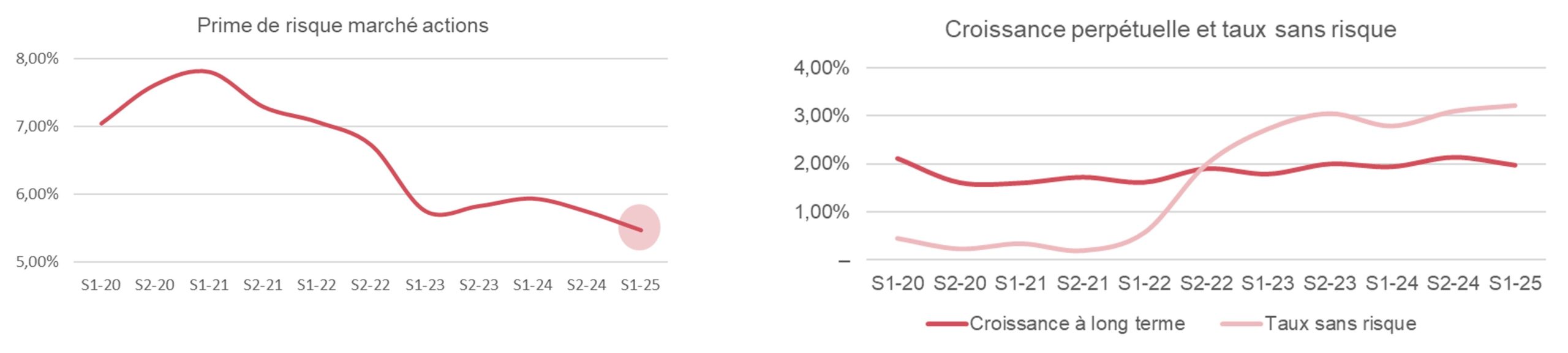
The equity market risk premium used in valuations in the decade leading up to 2022 stood at around 7.0 per cent. However, this premium has fallen over the last three years and stands at a historic low of 5.5 per cent in the first half of 2025.
This decline has not, however, resulted in a significant downward impact on the discount rates applied to cash flows, as we have observed a sharp rise in the risk-free rate over the same period.
The risk-free rate has, in fact, followed the trend in sovereign bond yields. Following a (slight) fall in the first half of 2024, the risk-free rate has risen again over the last twelve months.
A selection of articles on the subject
- Les Echos Investir, ‘Takeover bids: everything you need to know about takeover bids and delistings’ → Article link
- Vernimmen, “The challenging role of the independent expert in stock market transactions” → Article link
- L’AGEFI, “A holder of Neoen’s 2022 Oceanes bonds asks the AMF to suspend its compliance approval” → Article link
- L’AGEFI, “Independent expertise: a French speciality that is criticised but necessary for shareholder dialogue” → Article link
- L’AGEFI, “The Vivendi case is shaking up stock market doctrine in France” → Article link
- L’AGEFI, “Brookfield raises its offer for Neoen’s 2022 convertibles” → Article link
Disclaimer & contacts
This report has been prepared for information purposes only, based on SORGEM Evaluation’s databases compiled from publicly available information, notably on the AMF website.
The authors and SORGEM Evaluation accept no liability whatsoever for the transcription, analysis or interpretation of the information contained in this note.
Contacts for this study:
- Thomas HACHETTE, Partner, SORGEM Evaluation, thachette@sorgemeval.com, LinkedIn;
- Etienne LANGER, Director, SORGEM Evaluation, elanger@sorgemeval.com, LinkedIn;
- Mathilde FERRERO, Senior Consultant, SORGEM Evaluation, mferrero@sorgemeval.com, LinkedIn.

