
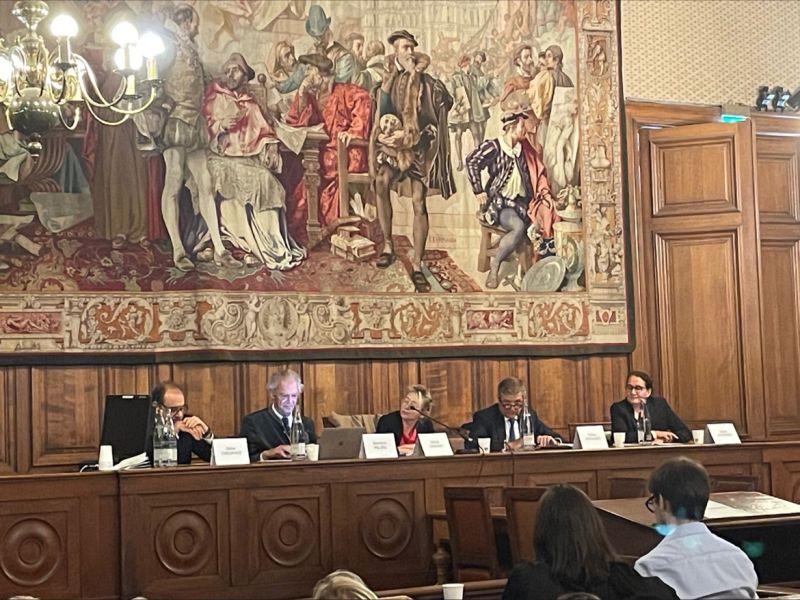
Claire Karsenti, a Partner at Sorgem Evaluation, spoke at the ‘Nuit du Droit’ on 4 October 2023 at the Paris Commercial Court as part of a round-table discussion on expert assessment and compensation for economic losses. She focused in particular on the role of the court-appointed expert and the party-appointed expert in economic matters (anti-competitive practices, abrupt termination of established commercial relationships, unfair competition, etc.).
She emphasised that, in the absence of a court-appointed expert, the judge must be able to rule between opposing positions on matters that are sometimes technical. Although there has been an improvement in the way experts present their findings and greater consistency in the presentation of reports, there is still room for improvement to promote greater transparency regarding assumptions and calculation methods, particularly in the most complex cases (such as econometric models, etc.). Many joint working groups comprising judges, lawyers and experts are addressing this issue.
She also emphasised that judicial expertise is a means of ensuring genuine equality of arms between the parties, because although the judicial expert is not there to compensate for the parties’ shortcomings, their technical expertise enables them to better understand the technical positions of each party. The issue of the time taken by judicial expert reports is often raised, but it must be recognised that this time is not really the expert’s fault: the time taken primarily reflects the adversarial nature of the proceedings, but it also reflects the attitude of the parties and their lawyers. Certain difficulties (deadlocks, refusal to cooperate, etc.) can, however, fortunately be resolved by the supervising judge; but in the meantime, the expert assessment has fallen behind schedule. So the key is certainly interaction with the judge, but also the behaviour of the parties and their lawyers during the judicial expert assessment.
 Article précédent